86-13511478976


Choosing the best moulding die manufacturers for 2026 isn’t just about comparing prices or flipping through fancy catalogs. Honestly, you really need to see the proof on the shop floor—things like stable cavity sizes, well-balanced cooling channels, solid steel certificates, and good support even after your order ships out. A moulding die might look absolutely perfect in the quote, but the real test is how it holds up after thousands of cycles. That’s when you really find out what it’s made of.
The demand in this industry is still huge, by the way. PlasticsEurope’s report, Plastics – the Facts 2024, shows that global plastics production hit around 414 million tonnes in 2023. And Grand View Research estimates that the worldwide injection-molded plastics market was worth roughly $198 billion last year. These numbers really highlight how crucial tooling choices are—because they directly affect production capacity, material waste, and how consistent your products turn out. But here’s the thing: just because a manufacturer has impressive numbers doesn’t mean they can always deliver dependable dies.
John Bozzelli—an injection molding expert and founder of Scientific Molding—often reminds folks that, ‘The mold is the heart of the injection molding machine.’ And honestly, that mindset shapes everything in this review. The top manufacturers tend to combine solid engineering, precise machining, mold-flow validation, and documented quality checks. They’re also upfront about what’s possible and where limits lie.
Let’s be real—no one’s perfect. As a buyer, you really need to question things like how long it takes to get your order, whether steel can be substituted, how easy it is to access maintenance points, and what kind of spare parts support they offer. Standards like ISO 9001 and ISO 20457 can certainly help you evaluate, but certifications alone don’t guarantee quality—trial runs and real-world results matter just as much.
This guide aims to compare manufacturers based on their technical skills, export experience, ability to customize, after-sales support, and the overall value of ownership. Keep in mind, though, that rankings aren’t set in stone—especially since the requirements for automotive interiors, medical devices, packaging, and consumer electronics vary a lot. That’s an important point to remember—things are different for each application, and that’s something you should be aware of, not ignore.
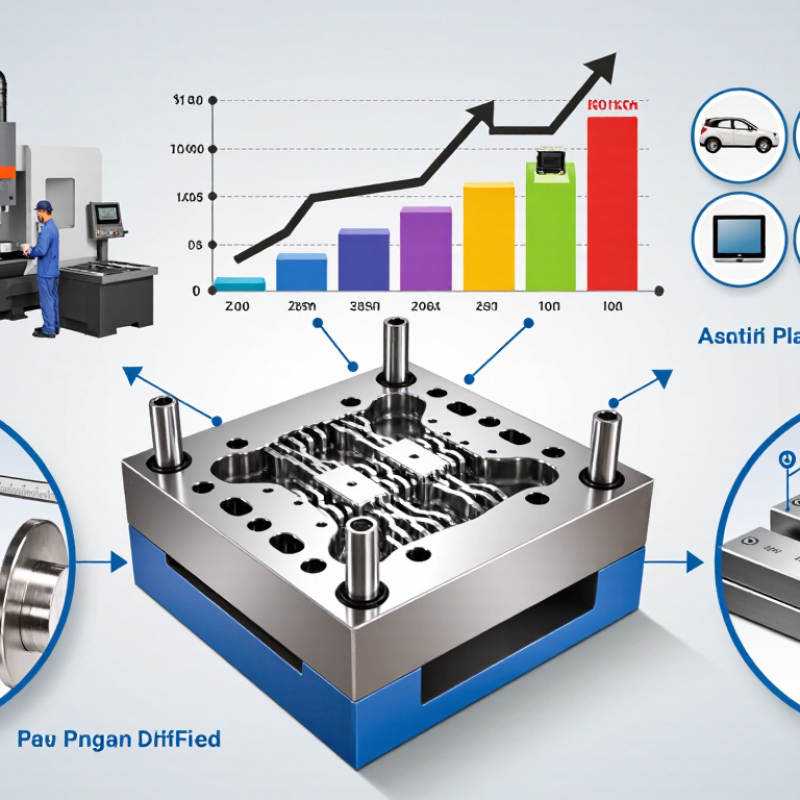
Moulding dies are precision tools that shape molten plastic, metal, rubber, or composite materials under controlled pressure. Their cavity defines the product’s geometry, while cooling channels, ejectors, and guides control release and repeatability. In practical production, a die is more than a metal block. It is a compact manufacturing system.
Moulding Die Design affects cycle time, surface quality, material waste, and maintenance frequency. A small imbalance in cooling can leave visible sink marks on a dashboard trim. Poor venting may trap air near a thin rib. These defects are expensive when production runs reach thousands of parts. Deloitte’s 2024 Smart Manufacturing Survey reported that 86% of manufacturing leaders expect smart manufacturing to become essential within five years. This pressure is pushing die makers toward sensors, simulation, and connected inspection.
The International Federation of Robotics’ World Robotics 2024 report recorded 541,302 industrial robot installations in 2023. Dies must now support faster, more automated work cells. Designers therefore study robot access, part release, tool changes, and data feedback before cutting steel. Experienced engineers also check warpage risks with flow analysis and physical trials. Digital models help, but they do not replace judgment. Not always.
A screen-perfect design can still fail after heat, pressure, and repeated cycling. That uncomfortable gap requires measurement, correction, and sometimes a redesigned insert. Reliable manufacturers document these lessons through trial records, dimensional reports, and controlled revisions.
For global buyers, evaluating Die Plastic Moulding manufacturers in 2026 requires evidence beyond attractive samples. Grand View Research reported strong expansion in the global injection molding machine market, with automation and precision remaining major growth drivers. This trend raises expectations for die accuracy, repeatability, and production data.
Ask for documented dimensional tolerances, material certificates, and inspection records from a coordinate measuring machine. A reliable supplier should explain cavity balance, cooling-channel design, tool steel selection, and expected service life. Request a trial report using your actual resin, wall thickness, and cycle time. Real production conditions reveal more than showroom parts.
Look closely at process control.
ISO 9001 certification can support consistency, but it does not guarantee excellent moulds. Review nonconformance rates, corrective-action records, and response times for engineering changes. MarketsandMarkets has identified smart manufacturing and connected production as important industrial trends; therefore, manufacturers should provide traceable revision histories and measurable machine data. I would also inspect maintenance access, spare-part planning, and export packaging. These details often decide whether a tool survives repeated ocean transport.
Cost deserves caution. A lower quotation may hide weaker steel, limited testing, or expensive modifications later. Still, every buyer should challenge optimistic service-life claims. Independent verification remains wise, especially when tolerances reach hundredths of a millimetre. Mistakes happen. The strongest manufacturer documents them, corrects them, and shows what changed.
For international buyers, selecting a moulding die manufacturer requires more than comparing prices. A capable supplier should explain steel grades, heat treatment, cavity layout, and expected service life in practical terms. Drawings must be reviewed against the final part, not accepted blindly. Small details matter. A 0.02 mm mismatch can affect assembly, flash, or surface finish. Experienced manufacturers usually provide design-for-manufacturing feedback before cutting metal. This step can reduce late revisions and shipping delays. Yet experience is not proof by itself. Buyers should request inspection records, trial reports, and clear evidence of repeatable quality.
Reliable moulding die manufacturers for global buyers understand that distance creates risk. They use controlled document versions, agreed approval points, and traceable material certificates. Video inspections can show polishing, fitting, and trial production without requiring immediate travel. Ask how the supplier handles cooling balance, venting, ejection marks, and replacement inserts. These questions reveal technical depth quickly. Communication also needs structure. A weekly report should identify completed work, open issues, photographs, and the next decision date. Silence is expensive.
International projects also require practical export preparation. Packaging should protect the die from moisture, impact, and corrosion during extended transit. Spare components, maintenance instructions, and lifting points should be documented in usable English. A responsible manufacturer will discuss local standards and confirm which tests apply to the buyer’s market. However, no supplier gets every decision right. Buyers should challenge vague promises, verify samples, and leave room for corrective work. The best partnership may still include an awkward revision meeting. That is often where reliability becomes visible.
Selecting a moulding die manufacturer starts with material discipline, not a glossy catalog. For high-volume work, hardened tool steel offers wear resistance and stable dimensions. Pre-hardened steel can reduce machining time for lower-stress applications. Carbide inserts suit abrasive compounds, but they demand careful handling and raise replacement costs. Stainless options help with corrosion concerns in humid production rooms. The right choice depends on resin, cycle count, pressure, and maintenance planning. It is not always the hardest material.
Reliable engineering should show measurable controls. Ask for cavity and core tolerances, surface-finish targets, heat-treatment records, and inspection reports. Coordinate measuring machines can verify critical dimensions, while trial shots reveal flash, sink marks, and uneven filling. Strong suppliers document steel certificates and protect revision history. International buyers should also check quality systems, traceability, and export-ready packaging. Standards matter. Yet a certificate proves little if operators cannot explain corrective actions.
Production capability includes design review, CNC machining, EDM, polishing, assembly, and testing under one controlled workflow. A manufacturer with in-house sampling can adjust gates or cooling channels faster. Ask how many cavities run simultaneously and how spare parts are managed. On-site experience has taught me that delivery promises often fail during final fitting, not rough machining. Some teams underestimate vent depth or thermal distortion. No process is flawless. Buyers should examine these weak points before approving mass production.
Choosing a Plastic Moulding Die Maker requires more than comparing quotations. Inspect sample parts under bright light. Look for consistent wall thickness, clean parting lines, and smooth ejection marks. Ask for steel certificates, dimensional inspection reports, and trial-shot records. A reliable supplier should explain cavity design, cooling channels, and expected tool life in practical terms.
Pricing needs careful interpretation. A cheaper die may exclude mold-flow analysis, spare inserts, or corrective trials. Request an itemized quotation with steel grade, cavity count, surface finish, packaging, and revision costs. Lead time should include design approval, machining, testing, and shipping. Ask for milestone dates, not only a final delivery promise. Delays often begin when technical questions remain unanswered.
Customization also shows a manufacturer’s real capability. Check whether engineers can adjust gate locations, draft angles, cooling layouts, and automation interfaces. Ask how changes affect price and schedule. In my experience, a confident answer is useful, but a documented answer is safer. One detail can be missed. Review the 2D drawing, 3D model, and first sample together before approving production.
Global buyers should assess moulding die manufacturers beyond catalogue prices. Plastic Moulding Die Design must match resin behavior, cycle time, tolerances, and local production conditions. A supplier should provide steel certificates, dimensional reports, trial-shot records, and revision-controlled drawings. These details make technical decisions traceable.
UNCTAD’s Review of Maritime Transport 2023 reports that over 80% of world merchandise trade by volume moves by sea. Shipping delays can therefore disrupt launch schedules. Buyers should request packaging specifications, spare-part plans, transport insurance, and a realistic response time for urgent repairs. Remote troubleshooting is useful, but it cannot replace access to replacement inserts and trained service engineers. In my experience, after-sales promises become meaningful only when response times and responsibilities appear in the contract.
Compliance also requires evidence, not attractive wording. ISO Survey data has recorded more than one million ISO 9001 certificates worldwide, yet certification alone does not prove stable mould quality. Audit the actual factory process, calibration records, subcontractor controls, and corrective-action history. Check material restrictions for the destination market before production begins. One overlooked resin requirement can create expensive rework. Risk remains.
A practical sourcing review should score technical capability, export documentation, service coverage, payment exposure, and business continuity separately. The weakest score deserves attention. A supplier may offer excellent machining but limited local support. That trade-off should be visible before the first deposit.
| Evaluation Dimension | Key Data Point | Practical Buyer Benchmark | Verification Evidence | 2026 Buyer Priority |
|---|---|---|---|---|
| Global Sourcing | Export capability | Ability to prepare commercial invoices, packing lists, certificates of origin, and transport documentation for international shipments. | Sample redacted shipping document set, export references, customs classification process, and nominated freight-forwarder procedure. | Required |
| Global Sourcing | Trade terms | Quotation should clearly identify the applicable Incoterms® 2020 rule, named place, insurance responsibility, and transfer point for risk. | Formal quotation using an Incoterms® 2020 rule such as EXW, FCA, FOB, CIF, or DAP, with all excluded costs listed. | Required |
| Global Sourcing | Multi-region logistics | Documented options for sea, air, and courier transport, including packaging suitable for moisture, vibration, and long-distance handling. | Packaging specification, corrosion-protection method, crate dimensions, gross weight, and logistics contingency plan. | Recommended |
| Technical Capability | Design-for-manufacturing review | Formal review of parting line, draft angle, wall thickness, shrinkage allowance, ejection, cooling, and likely moulding defects before tool release. | Signed DFM report, mould-flow analysis where appropriate, 3D design approval record, and revision-controlled drawings. | Required |
| Technical Capability | Dimensional control | Measurement method must match the drawing tolerance and functional requirements; critical dimensions should have defined inspection frequency. | CMM or calibrated measuring-equipment records, inspection plan, gauge list, and sample dimensional report. | Required |
| Materials | Tool-steel traceability | Steel grade, heat number, hardness condition, and heat-treatment status should be traceable to the mould component or insert. | Material certificate, heat-treatment report, hardness readings, and component-level traceability record. | Required |
| Materials | Common steel selection | Material selection should reflect production volume, resin abrasiveness, corrosion risk, surface finish, and expected maintenance interval. | Material-selection rationale covering corrosion-resistant, pre-hardened, or hardened steel options where technically justified. | Recommended |
| Compliance | Quality management | ISO 9001:2015 certification is a useful baseline for controlled processes, documented procedures, corrective action, and continual improvement. | Current certificate issued by an accredited certification body, scope covering tooling or mould manufacturing, and latest audit status. | Recommended |
| Compliance | Automotive supply chain | IATF 16949 is relevant when the toolmaker supplies automotive production programs or must meet automotive customer-specific requirements. | Valid IATF 16949 certificate or documented alignment with the buyer’s automotive quality requirements and PPAP process. | Application-Based |
| Compliance | Chemical and product restrictions | For regulated markets, material and process controls may need to support applicable REACH and RoHS obligations; the mould itself is not automatically compliant merely because it is used in a compliant product. | Supplier declarations, material declarations, restricted-substance controls, and buyer-specific compliance questionnaire. | Verify by Market |
| Quality Assurance | First-off validation | Tool acceptance should include trial samples, dimensional inspection, appearance review, cycle conditions, and a documented punch-list closure process. | Trial report, approved sample parts, dimensional report, process conditions, defect log, and signed acceptance record. | Required |
| Quality Assurance | Process capability | For critical production characteristics, the buyer should define capability expectations and the statistical method before production validation. | Control plan, capability study where applicable, measurement-system analysis, and agreed critical-to-quality characteristic list. | Recommended |
| Project Management | Milestone control | Project plans should cover design freeze, steel order, machining, assembly, first trial, modifications, final inspection, and shipment. | Gantt schedule, weekly progress report, photo record, open-issue register, and escalation contact list. | Required |
| Project Management | Change management | Design or material changes must be approved before implementation and linked to a revision-controlled drawing or specification. | Engineering-change request, approval workflow, revision history, and documented impact assessment for cost and timing. | Required |
| After-Sales Service | Warranty definition | Contract should define warranty period, covered defects, exclusions, response time, corrective-action responsibility, and transport costs. | Signed warranty clause, service-level commitment, nonconformance procedure, and replacement-part responsibility matrix. | Required |
| After-Sales Service | Spare-parts support | High-wear items such as ejector pins, seals, springs, inserts, and cooling-line components should have identifiable part numbers and replacement specifications. | Spare-parts list, exploded assembly drawing, recommended inventory, and ordering lead-time information. | Recommended |
| After-Sales Service | Remote troubleshooting | Support should include structured fault diagnosis using mould drawings, process data, photographs, trial samples, and corrective-action records. | Service contact matrix, response-time commitment, troubleshooting form, and examples of anonymized corrective-action reports. | Recommended |
| Risk Management | Single-source exposure | Critical steel, standard components, heat treatment, surface treatment, and machining capacity should be assessed for single-source dependency. | Approved-supplier list, capacity review, alternative-source plan, and documented business-continuity assessment. | Required |
| Risk Management | Business continuity | Supplier should maintain contingency arrangements for power interruption, equipment failure, labor disruption, cyber incidents, and logistics delays. | Business-continuity plan, backup equipment information, data-backup procedure, emergency contacts, and recovery priorities. | Recommended |
| Risk Management | Intellectual property protection | Confidential drawings, 3D files, specifications, and production data should be protected through access control and contractual confidentiality obligations. | Non-disclosure agreement, access-control policy, file-transfer procedure, employee confidentiality terms, and data-retention policy. | Required |
| Commercial Control | Total cost of ownership | Evaluation should include tool price, engineering changes, trial costs, freight, duties, spare parts, maintenance, and expected downtime—not quotation price alone. | Itemized quotation, assumptions list, tooling-maintenance estimate, spare-parts pricing, and landed-cost calculation. | Required |
| Commercial Control | Payment protection | Milestone payments should be linked to verifiable deliverables such as design approval, steel certification, successful trial, and final acceptance. | Purchase agreement, milestone acceptance criteria, retention or holdback terms, and dispute-resolution clause. | Recommended |
| Sustainability | Environmental management | ISO 14001 certification can indicate a structured environmental-management system, but the certificate scope and actual process controls should still be reviewed. | Current ISO 14001 certificate, environmental objectives, waste-handling records, coolant-management controls, and applicable permits. | Verify Scope |
| Selection Method | Evidence-based approval | Final supplier approval should be based on audited evidence, technical fit, total cost, compliance, delivery risk, service capability, and contractual protection. | Completed supplier questionnaire, audit report, technical scorecard, risk register, corrective-action closure, and signed commercial terms. | Required |
FRP water tank panel moulds are increasingly designed around the demands of hydrostatic testing, where panels must maintain dimensional stability, watertightness, and structural strength under sustained internal pressure. Compression moulding provides consistent fibre-resin distribution and repeatable panel geometry, helping manufacturers produce sections that fit accurately during tank assembly. As testing requirements become more demanding, mould rigidity, controlled heating, and reliable pressure distribution are becoming key considerations in production planning.
The mould can be manufactured from P20, S50C, or S45 steel, depending on the expected production volume, surface requirements, and budget. A single-cavity configuration is suitable for flexible or lower-volume production, while multiple cavities can improve output and consistency. Multiple cavities with interchangeable inserts offer additional adaptability when panel sizes, textures, or connection details change. Oil heating or electrical rod heating can be selected to maintain stable mould temperatures and support uniform curing during compression cycles.
For efficient demoulding, hydraulic ejection with air assist or hydraulic pins can reduce panel damage and improve handling speed. With appropriate maintenance and operating conditions, a P20 mould may support approximately 300,000 cycles, although actual service life depends on materials, pressure, temperature, and processing control. A typical lead time is around 50 days, allowing sufficient time for mould design, steel preparation, machining, heating-system installation, and trial verification before hydrostatic testing begins.
Hardened tool steel offers strong wear resistance and stable dimensions. It suits demanding, repeated production. Not always the hardest option. Resin type, pressure, cycle count, and maintenance also matter.
Pre-hardened steel can shorten machining time for lower-stress applications. Carbide inserts suit abrasive compounds but require careful handling. Replacement costs may be higher. The cheapest choice can disappoint later.
Request steel certificates, heat-treatment records, dimensional inspection reports, and surface-finish targets. Ask for cavity and core tolerances. Revision history should remain traceable. A certificate proves little without clear corrective actions.
Trial shots can expose flash, sink marks, uneven filling, and poor ejection. Inspect sample parts under bright light. Check wall thickness and parting lines. Small defects often predict larger production troubles.
It should list steel grade, cavity count, surface finish, packaging, testing, and revision costs. Confirm whether spare inserts and corrective trials are included. A low price may hide important work.
Lead time should cover design approval, machining, fitting, testing, and shipping. Request dated milestone targets, not one final promise. Add a small buffer. Final fitting can cause unexpected delays.
Engineers should explain changes to gate locations, draft angles, cooling channels, and automation interfaces. Ask how each change affects cost and schedule. Documented answers are safer than confident promises.
Compare three written quotations using identical drawings and requirements. Review cavity design, cooling layouts, tolerances, tool life, and packaging. Request dated progress photos. I might miss one detail, so review the first sample carefully.
This 2026 guide explains how a Moulding Die supports modern manufacturing by shaping materials with accuracy, repeatability, and efficient production cycles. It outlines the main criteria for evaluating manufacturers, including engineering expertise, dimensional precision, material selection, tooling durability, quality control, and the ability to develop customized solutions. Readers will also learn how production capacity, technical communication, and adherence to recognized engineering standards can influence long-term performance.
For international buyers, the guide provides a practical framework for comparing quality, pricing, lead times, customization, and total ownership costs. It also addresses global sourcing considerations such as documentation, compliance requirements, packaging, logistics coordination, after-sales support, maintenance guidance, and risk management. By reviewing these factors together, buyers can identify reliable manufacturing partners, reduce supply-chain uncertainty, and select moulding solutions that deliver consistent results across different production environments.